README.md
gno.land/p/moul/x/wiki/v0
A Wikipedia-shaped wiki engine: namespaced titles, an append-only revision chain, wikilinks with backlinks, categories, redirects, protection levels, per-page discussion threads, line diffs, and markdown rendering.
Pure: no realm globals, no chain imports. Every mutating call takes the author address, the wall clock and the block height from its caller, so the engine is unit-testable off-chain and the realm keeps all the authority.
Live demo: gno.land/r/moul/x/wiki/v0.
The storage model
A realm write locks a storage deposit proportional to the bytes it adds
(100ugnot per byte, gnolang/gno#6171). A wiki that kept every revision in
full would therefore charge its editors rent on the whole history forever: at
5 KB per revision that is 0.5 GNOT locked per edit, permanently.
This engine keeps a content-addressed spine plus a bounded body window:
| kept forever, per revision | kept only inside the window |
|---|---|
| id, parent, kind, author, time, height, summary, byte size, SHA-256 of the body, minor flag | the body text |
Roughly 200 bytes per revision regardless of article size, plus the bodies of
the newest Retention revisions of each page (3 by default).
An evicted body is not lost. Its bytes were an argument of the transaction
that wrote it, so they are still in the chain's transaction history, and the
retained hash proves which bytes were the real ones. The realm stops paying
rent for deep history; the archive lives where archives belong. What you lose
is the ability to diff or revert to an evicted revision from inside the realm,
and both failures are explicit (ErrBodyEvicted) rather than silent.
Purge evicts every body of a page at once and returns the bytes released. It
is the lever for content that must stop being served out of realm state; it
cannot and does not remove the transactions that wrote it.
Who gets the deposit back
Not who paid it. Verified in processStorageDeposit
(gno.land/pkg/sdk/vm/keeper.go, gno master, 2026-09-19):
- A write sends the caller's ugnot to a per-realm deposit address and adds
to two realm-wide pools,
rlm.Depositandrlm.Storage. There is no per-depositor accounting. - A release refunds
rlm.Deposit * released / rlm.Storage(big-integer, truncating, so dust accrues in the pool) to the caller of the transaction that frees the bytes, at the realm's blended rate. - If ugnot is a restricted denom at the time, the refund goes to
params.StorageFeeCollectorinstead, not to any user.
For a wiki that inverts a comfortable assumption. Adding bytes costs the adder,
but removing bytes pays the remover. Replacing a long article with a short
one evicts an old body in the same transaction, so deletion can be profitable,
and reverting the damage costs the good actor who reverts it. That asymmetry is
why Blank, Purge and HideComment are steward-gated, and why the realm
keeps a ban list, protection levels and an optional cooldown rather than
relying on the deposit alone.
Rendering untrusted markdown
Article bodies are attacker-controlled markdown rendered by gnoweb, so the render path has a fixed order:
sanitize.BlockRichthe body (gno.land/p/nt/markdown/sanitize/v0).- Then rewrite the wikilinks.
Not the other way around. The sanitizer escapes every [, so [[Gno land]]
becomes \[\[Gno land\]\] in its output; a rewriter that ran first would hand
the markdown links it just generated to the escaper and every link on the wiki
would render as literal text. That is why ScanLinks takes its delimiters as
parameters: indexing scans the raw body, rendering scans the escaped one.
The blank lines BlockRich adds around its output are load-bearing, not
cosmetic. A CommonMark HTML block of type 6 or 7 is not escaped in any mode,
and without the surrounding blank line it would absorb the realm chrome
appended after the body.
Two layers, two jobs: sanitize stops markdown structure injection, and
gnoweb's own link extension stops URL scheme abuse (javascript: and
friends). Neither replaces the other.
The title charset is narrower than MediaWiki's for the same reason. /, |,
#, *, [, <, ?, % and & are rejected rather than escaped, which
keeps Title.String, Title.Slug and the rendered link byte-identical.
TestTitleSurvivesTheRenderPipeline pins that coupling end to end.
Determinism and gas
Render runs under maxGasQuery (3e9 in gno.land/pkg/sdk/vm/keeper.go),
which a reader cannot raise, so an unbounded render makes a page permanently
unreadable. Three bounds keep it away from that ceiling:
MaxBody(32 KiB) caps a revision, and therefore caps every render.DiffMaxLines(80) caps the changed region a diff computes exactly. The common prefix and suffix are trimmed first, so an ordinary edit to a long article still diffs exactly; past the bound a diff degrades to a block replacement instead of failing.- Histories, indexes and listings are paginated by the caller.
Measured with gno test -v on gno master.184 (2026-09-17): the diff of a 33 KB
body against itself plus one line costs 691M gas, and the article render of a
33 KB body with links costs 693M, each about 23% of the ceiling.
Everything else follows gno's determinism rules: no map iteration anywhere in a
render path, avl for every ordered index, and namespace keys padded by hand
because ufmt has no width flags (ufmt.Sprintf("%02d", 7) silently returns
"7", which would sort User between two main-namespace pages).
Discussion
Discussion is an append-only comment store attached to a page, not a Talk:
article. A talk page is an article, so whoever edits last can rewrite what
someone else said, and moderating one bad message means editing the whole page.
A comment store gives each message its own author, timestamp and moderation:
HideComment clears one body and releases its bytes while the message stays in
the thread, marked as removed.
Replies nest exactly one level (MaxReplyDepth). Deeper nesting needs
recursive rendering with no natural bound, which is the shape a query gas
ceiling punishes hardest. Comments are sanitized like article bodies but are
not a wikilink slot: brackets in a comment stay literal.
Wiki syntax
| syntax | meaning |
|---|---|
[[Target]] |
link, rendered from the canonical title |
[[Target|label]] |
link with a display label |
[[Category:Name]] |
join a category; removed from the text flow |
[[:Category:Name]] |
link to the category instead of joining it |
#REDIRECT [[Target]] on line 1 |
redirect, followed one hop only |
Links to pages that do not exist yet are still indexed, so creating a page immediately knows who was already pointing at it.
Known limits
Page.Revision(id)is a linear scan of the page's history, and so is comment lookup within a thread.- Redirects are followed one hop; chains are not resolved.
- Templates and transclusion are not implemented.
- There is no full-text search, and there cannot be a cheap one on chain.
Part of moul/gno-contracts — moul's versioned gno.land contracts. See the repository for the full catalog, build/test tooling, and usage.
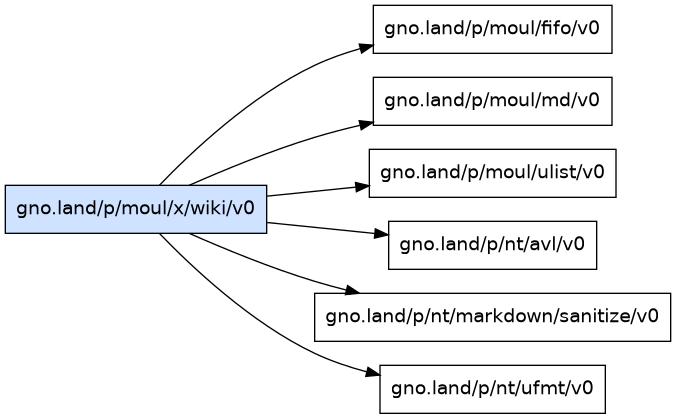
Dependency graph:
🧪 Highly experimental — potentially vibe-coded. Not audited; may break, change, or be removed at any time. Do not use with anything of value. Full disclaimer: DISCLAIMER.
