README.md
gno.land/r/moul/reactions/v0
A reaction block any realm can embed, keyed on the page it appears on rather than on the realm that stores it.
It is the shape the web settled on for this in 2010: one hosted widget, the same snippet pasted everywhere, deciding what to show from the page identifier it is handed. Here the snippet is two lines of gno.
1import "gno.land/r/moul/reactions/v0"
2
3func Render(path string) string {
4	return body + reactions.RenderBlock()
5}
That is the whole integration. Your realm stores nothing, registers nothing and configures nothing, and redeploying it never loses anyone's reaction.
Why RenderBlock needs no argument
A plain read exported by one realm and called by another is borrowed: gno
opens no realm frame for it, so unsafe.CurrentRealm() inside it reports the
caller. RenderBlock uses that as the page key, which is why the same line
does the right thing in every realm that pastes it. (Measured on
gnolang/gno@master 2026-09-22, recorded in this repo's AGENTS.md; it is the
same mechanism behind r/moul/config's TopBlock.)
Adding a cur realm parameter would silently reverse it and key every embed to
this realm, which is exactly why there is none.
RenderBlockFor(page) is the explicit form: use it from a crossing function,
where there is no caller to read off the stack, or to key one block per article
on the path you already serve.
1return body + reactions.RenderBlockFor("gno.land/r/you/blog:" + path)
What it is, and what it refuses to be
Not a comment system. There is no text field anywhere, which is what lets it run with no moderation at all: a closed palette of six, one reaction per address per page, changeable and removable. The block shows the tally and who reacted last. That is the feature.
| key | |
|---|---|
up |
👍 |
heart |
💜 |
fire |
🔥 |
party |
🎉 |
rocket |
🚀 |
eyes |
👀 |
React aborts on anything else. That is the entire content policy, and it is a
compile-time constant rather than a list someone has to curate.
The surface
React(cur, page, key) |
record the caller's reaction. Reacting again with a different key moves it; with the same key it only updates the "last reaction" line |
Unreact(cur, page) |
remove it. Aborts when there is none, rather than succeeding silently |
RenderBlock() |
the embed, keyed on the calling realm |
RenderBlockFor(page) |
the embed for a named page |
Count · CountOf · ReactionOf · Last · Pages |
reads, for a host realm that wants the numbers without the markdown |
Render("") is the getting-started page plus the board;
Render("<page>") is one page's tally, which is where the link under every
block goes.
Two things that are permanent, and were decided on purpose
This realm is public, so it can never be redeployed. A private realm cannot
be imported at all, and being imported is the entire feature. The redeploy that
private = true would have bought is given up deliberately: the tallies under
this path belong to everyone who reacted, not to the deployer, and a redeploy
wipes every package-level variable. A fix ships as a v1 beside this one that
keeps reading it, never as a replacement.
The page key is not checked against anything. A page is just a name: nothing verifies that the realm exists, that it embeds the block, or that the caller has any relationship to it. That is what lets a realm key the block on something finer than itself, and it means the board index is an open list. The index is capped at 25 rows for that reason; every page keeps its own view regardless.
Not to be confused with
r/moul/x/daily/reactions
is an older, unrelated experiment: a single self-contained board with its own
"topics", no embedding, and no way for a reader to change or remove a reaction.
Nothing is shared between the two.
Where the code is
The engine (pages, tallies, palette, the block markdown) is
p/moul/reactions/v0.
This realm is the authority half: who may write, what the chain says the height
and the caller are, and the two views.
First host: r/moul/home,
which renders it as a :reactions: layout placeholder.
Part of moul/gno-contracts — moul's versioned gno.land contracts. See the repository for the full catalog, build/test tooling, and usage.
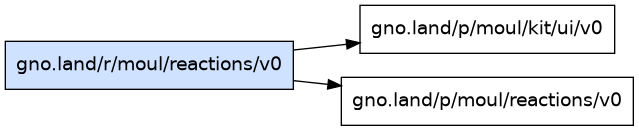
Dependency graph:
⚠️ Disclaimer: provided as-is, without warranty; not security-audited. Full disclaimer: DISCLAIMER.
