/p/moul/kit/index/v0
index
The secondary index every realm with a store was writing by hand: a lookup from
a key a human typed to the store.IDs that carry it.
1import (
2 "gno.land/p/moul/kit/index/v0"
3 "gno.land/p/moul/kit/store/v0"
4)
5
6var notes = store.Named("note")
7var byTag index.Index // the zero value is an empty, usable index
8
9func Post(cur realm, tag, body string) int64 {
10 id := notes.Add(¬e{Tag: tag, Body: body})
11 if err := byTag.Add(tag, id); err != nil {
12 panic(err) // the store write is not committed either: same frame
13 }
14 return int64(id)
15}
16
17func Render(path string) string {
18 for _, e := range byTag.Page(1, 20) { // keys ascending, one page
19 _, _ = e.Key, e.IDs
20 }
21 return ""
22}
Fifth package of the p/moul/kit/* layer, after ui, store, num and
tally. Live demo: r/moul/x/kitindexdemo.
What it is not
Not a multi-index record store. p/moul/collection is
that, and measured at n = 1,000 an update there costs 964,833 gas against the
508,977 that created the record, because Update removes and re-adds every
index entry for every index whether or not the indexed value changed. Two
containers written side by side cost a third of that, and the realm can see what
it is paying for.
Not a bound. An index grows with the store it indexes. The realm owns the bound, because only the realm knows what it is willing to pay a storage deposit for.
The decisions worth knowing
Backed by a B+ tree at fanout 32, not avl, and not 128. A wider node is
cheaper to store and to insert into, measured against gno master 1fc4c140e on
2026-09-29, n = 1,000, string values:
| backing | bytes/entry | gas/insert |
|---|---|---|
bptree fanout 128 |
592 | 152,975 |
bptree fanout 32 |
671 | 162,161 |
avl |
2,029 | 417,811 |
But an index's keys are removed whenever its records move, and a removal
rewrites every later value in its leaf. Measured on a real node against gno
master 3cc494ec4 on 2026-10-02: removing the first key of a fanout-128 leaf
holding 120 cost 35.3M gas, the last 8.0M, about 230k per value shifted (its
values are *entry, a pointer). At 32 one removal rewrites about 45 values at
most (its own leaf, and a neighbour's when the leaf underflows and borrows), so
it is the cheaper default for something that moves.
The ids under a key are kept ascending, not in insertion order. So Lookup
depends on the set of ids and not on the order they arrived in: two realms
that indexed the same records in a different order render identically. A
Render whose output depends on insertion history is a determinism bug, and
this is where it would have come from.
Lookup and Each hand out a copy. Returning the stored slice would make
every caller a writer: an assignment into it corrupts the index with no write
path having been called. A realm that passes the result onward is passing its
own data, not a handle to ours.
The Index itself is a handle. Its state sits behind one pointer, so a copy
taken after the first write (or of anything Unique() returned) is the same
index, and Len can never disagree with Keys about what it holds.
API
New(), Unique() |
many ids per key, or at most one. The zero value is New() |
Add(key, id) error |
idempotent for the same pair; ErrEmptyKey, ErrZeroID, ErrDuplicateKey |
Remove(key, id) bool, RemoveKey(key) int |
a key whose last id goes is removed with it |
Lookup(key) []store.ID, First(key) (store.ID, bool) |
ascending; a copy |
Has, Count(key), Keys(), Len(), IsUnique() |
Keys counts keys, Len counts pairs, and the difference is the fan-out |
Each(fn) bool |
ascending by key; true means stop, matching bptree and kit/store. fn must not write to the index |
Page(page, size) []Entry, Pages(size) int |
1-based, every out-of-range page is nil (kit/store's Page returns an empty slice instead), Pages is never 0 |
Add returns an error rather than aborting, because a p/ package does not
know the caller's policy. In a realm the handling is almost always panic(err):
every one of the three is a bug in the realm rather than a value a user chose.
Part of moul/gno-contracts — moul's versioned gno.land contracts. See the repository for the full catalog, build/test tooling, and usage.
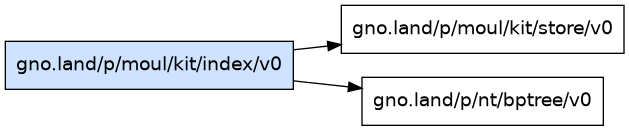
Dependency graph:
⚠️ Disclaimer: provided as-is, without warranty; not security-audited. Full disclaimer: DISCLAIMER.
