/p/moul/kit/store/v0
gno.land/p/moul/kit/store/v0
The auto-id ordered collection every r/moul realm was building by hand: an
avl.Tree, an int counter, and a private function that zero-pads the counter
into a key so the tree iterates in the order a human expects.
Second package of the p/moul/kit/* layer
(moul/gno-contracts#151).
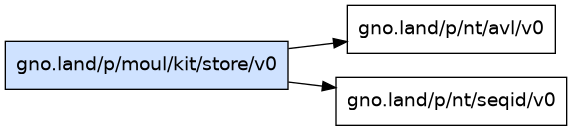
kit composes the existing packages, it does not replace them.
Why it exists
Sixteen realm files in this repo carry that third piece. They do not agree:
| Name | Width | Implementation | Realms |
|---|---|---|---|
padID |
6 | for len(s) < 6 { s = "0" + s } |
asciiart |
pad |
12 | for len(s) < 12 { s = "0" + s } |
tictactoe |
key |
12 | the same loop, a different name | blog, crowdfund, englishauction, erc721, splitter |
idKey |
12 | the same loop again, a third name | connect4 |
idKey |
12 | strings.Repeat, guarded by len(s) >= width |
governor, todos |
idKey |
12 | strings.Repeat, unguarded |
timecapsule |
seqKey |
16 | strings.Repeat, guarded |
guestbook |
Five names, three widths, three implementations, one job, across 16 files in 12 realms.
Every one of them is a silent ceiling. The key is a decimal string, and
decimal strings do not sort numerically. Below the width the zero-padding hides
that; at the width the padding stops and the tree starts ordering
"1000000000000" before "999999999999", so every list the realm renders is
wrong from that entry on. Nothing fails, nothing logs, the order is just quietly
false.
The unguarded variant fails harder. strings.Repeat panics on a negative count,
so past its width timecapsule stops accepting writes rather than mis-sorting
them.
asciiart's width of 6 puts its ceiling at one million entries.
Both tests live in
store_test.gno (TestOrderSurvivesThePaddingCeiling,
TestUnguardedPadPanicsPastItsWidth), asserting the defect rather than
describing it.
The fix is to delete the decision
Keys are the big-endian bytes of a
p/nt/seqid ID: a fixed 8 bytes whose lexicographic order
is numeric order, for every value a uint64 can hold. There is no width to
pick and no width to outgrow. seqid already solved this and was imported by
exactly one file in the repo.
 1import "gno.land/p/moul/kit/store/v0"
 2
 3var games = store.Named("game")             // or `var games store.Store`
 4
 5func NewGame(cur realm) int64 {
 6    return int64(games.Add(&Game{Board: empty, X: caller()}))
 7}
 8
 9func Move(cur realm, gameID int64, cell int) {
10    g := games.MustGet(store.ID(gameID)).(*Game)   // panics "game #7 not found"
11    ...
12}
13
14func Render(path string) string {
15    for _, e := range games.PageReverse(1, 20) {   // newest first, one page
16        g := e.Value.(*Game)
17        ... e.ID ...
18    }
19}
API
New() |
a new empty store; the zero Store works too |
Named("game") |
the same, with a noun for the MustGet panic |
Add(v) ID |
store under the next ID |
Set(id, v) bool |
write at an explicit ID, reports a replacement |
Get(id) (any, bool) |
value and presence, so a stored nil is not "absent" |
MustGet(id) any |
or panic store: no entry #7, or game #7 not found when named |
Has(id), Remove(id), Len(), LastID() |
|
Each(fn), EachReverse(fn) |
every entry, ascending / descending |
EachUntil(fn) bool, EachReverseUntil(fn) bool |
stop when fn returns true |
Page(page, size) []Entry |
1-based, ascending |
PageReverse(page, size) []Entry |
1-based, newest first |
Pages(size) int |
for the pager footer |
ParseID(s) (ID, bool), ID.String(), ID.Key() |
the path round trip |
IDs stay plain integers
An ID is a uint64 that renders as a decimal number, so a realm ported to
this package keeps showing #7 exactly as it did. Only the avl key changes, and
the key was never user-visible.
IDs start at 1, so the zero ID is usable as "absent" and ParseID("0")
rejects. Removing an entry does not free its ID: IDs are a history, not a
dense index, and reusing one would silently repoint an old link at a new object.
Two iteration shapes, on purpose
Each takes no stop signal. It is the common case, and a callback whose bool
means "stop" reads identically to one whose bool means "continue", so the
wrong guess is invisible. When iteration has to end early the name says so:
EachUntil, where true means stop, matching avl.IterCbFn exactly. A
callback moved between this package and a raw tree keeps its meaning.
Paging is 1-based and forgiving
Page numbers are shown to a reader ("page 1 of 4"), and an off-by-one between
the URL and the label is the bug this avoids. A page past the end, or a page or
size below 1, returns an empty slice rather than panicking, because the page
number usually arrives from a Render path and that is user input. Only the
requested window is walked, not the whole tree.
Design rule
The safe, conventional thing must be the shortest thing to type. Add is
shorter than nextID++ plus a padding function, and it cannot be got wrong.
That is the only mechanism that stops this helper from being written a
seventeenth time.
Part of moul/gno-contracts — moul's versioned gno.land contracts. See the repository for the full catalog, build/test tooling, and usage.
Dependency graph:
⚠️ Disclaimer: provided as-is, without warranty; not security-audited. Full disclaimer: DISCLAIMER.
