v0 source pure
Package pilot is a realm-driven account: one realm holds the funds and the identity, a key pilots it, and its powers ...
View source
gno.land/p/moul/pilot/v0
A realm-driven account: one realm holds the funds and the identity, a key pilots it, and its powers arrive afterwards as separate realms it never imports. The gno answer to a Gnosis Safe with modules.
Live instance: r/moul/pilot. A power:
r/moul/x/pilotdemo.
Why it is not just a multisig
gno has no dynamic call: a realm cannot invoke an arbitrary package path with runtime-built arguments. So an account can never execute arbitrary calldata the way a Safe does. Every outbound action has to be Go code in some realm.
The inversion that makes it work: the account is deployed once and stores Module values
handed to it by realms that did not exist at the time. The power is the calldata, published
as readable source, and installing one costs no redeploy of the account.
The two grants, and the only difference that matters
GrantPurse |
GrantIdentity |
|
|---|---|---|
| spends | the main treasury, metered | its own sub-treasury account#subpath |
| can act as the account toward other realms | no | yes |
Revoke takes it back |
yes, immediately | no, never |
A Purse is a type this package declares, so every call on one re-enters this code and
re-reads the live roster and budget. A module that stashed a purse and calls it a year later
still goes through the check.
A sub-identity token is the opposite. The token itself cannot be persisted, but
banker.NewBanker authorizes at construction and re-checks nothing ever again, so a module
can mint one from the lent token and keep it. Revoke shuts the account's door and does not
reach that banker. The blast radius is exactly what the sub-address was funded with, and it
is permanent. Grant an identity only to code you have read, and note that you can read it:
module source is on chain before you approve it.
Shape
 1// once, from the account realm
 2acct := pilot.New(0, cur)
 3
 4// the owner, through the account realm's crossing functions
 5acct.Approve(0, cur, "gno.land/r/you/somepower/v0", "power", pilot.GrantPurse, 1_000)
 6acct.Fund(0, cur, path, 500)
 7acct.SetBudget(0, cur, path, 2_000)
 8acct.Revoke(0, cur, path)
 9acct.Exec(0, cur, path, args)
10
11// the module realm, with its own cur: the account reads the path from the
12// runtime and never from an argument
13h := account.Handle()
14h.Register(0, cur, self)
15purse := h.PurseFor(0, cur)
Both realms in the pair must be public
A module's object is persisted in the account's roster, and a value of a type defined in a
private realm cannot be persisted by anyone else. A private account realm cannot be imported
at all, and a redeploy would wipe the owner, the roster and every budget while leaving the
coins at the address. private = true is wrong for both halves, and each gnomod.toml says
so.
Part of moul/gno-contracts — moul's versioned gno.land contracts. See the repository for the full catalog, build/test tooling, and usage.
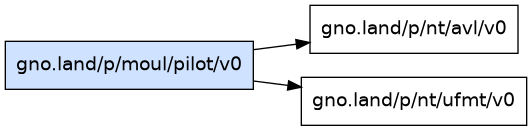
Dependency graph:
⚠️ Disclaimer: provided as-is, without warranty; not security-audited. Full disclaimer: DISCLAIMER.
Package pilot is a realm-driven account: one realm holds the funds and the identity, a key pilots it, and its powers are separate realms installed afterwards without ever redeploying it. The gno answer to a Gnosis Safe with modules.
An account realm keeps a *Pilot private and hands modules a narrow Account handle. Everything privileged stays on *Pilot, which is never returned, so a module can only reach the two methods it needs.
Two ways to delegate, and they differ in exactly one property:
- A Purse is revocable. Every method on it re-enters the declaring package and re-checks the live roster and budget, so Revoke and SetBudget take effect immediately, even on a purse a module retained.
- A sub-identity token (rlm.Sub) is permanent. It lets the module act as "<account>#<subpath>" toward any other realm, which a purse cannot do, but the module can mint a banker from it and keep it forever. Removing the module does not take that back; only emptying the sub-address does. Grant one only to code you have read.
Live instance: r/moul/pilot. Demo module: r/moul/x/pilotdemo.
1
1
var ErrNotOwner, ErrNotApproved, ErrNotInstalled, ErrRevoked, ErrOverBudget, ErrStaleRealm, ErrBadName
1var (
2	ErrNotOwner     = errors.New("pilot: not the owner")
3	ErrNotApproved  = errors.New("pilot: path not approved")
4	ErrNotInstalled = errors.New("pilot: module not installed")
5	ErrRevoked      = errors.New("pilot: module revoked")
6	ErrOverBudget   = errors.New("pilot: over budget")
7	ErrStaleRealm   = errors.New("pilot: stale realm value")
8	ErrBadName      = errors.New("pilot: a path and a subpath are [a-zA-Z0-9._/-] and not empty")
9)1
5
type Account
structAccount is the module-facing half: two methods, both keyed on the calling realm's OWN pkgpath, which a realm cannot forge for another.
type Grant
identGrant says what a module was given.
type Module
interfaceModule is implemented by a module realm and installed into an account. The account never imports it: it learns the module only as this interface.
Run is threaded (the leading int keeps it out of crossing-function territory, which a /p/ package may not declare). rlm is whatever the account chose to delegate: its own sub-identity token for a trusted module, or a zero value when the module was installed purse-only.
type Pilot
structPilot is the account. The realm that constructs it owns it and must not hand it out; hand out Pilot.Handle instead.
Methods on Pilot
func Address
method on PilotAddress is the account's main treasury.
func Approve
method on PilotApprove authorises a package path to install itself later. The code does not have to exist yet, which is the whole point: the account is deployed once and learns new powers afterwards.
func AssertOwner
method on PilotAssertOwner panics unless the user behind rlm owns the account. Only the account realm may call this: rlm must be its own live cur, so that rlm.Previous() is the signer and not some intermediary's caller.
func Exec
method on PilotExec drives an installed module. rlm must be the account realm's own live cur: an identity grant mints its sub-token from it, which only the account realm's namespace can do.
func Fund
method on PilotFund moves coins from the account's main treasury into a module's sub-treasury. For an identity grant this is the permanent blast radius.
func Handle
method on PilotHandle is what an account realm exposes to modules.
func Host
method on Pilotfunc Owner
method on Pilotfunc Render
method on PilotRender is the account page. The account realm forwards its Render here.
func Revoke
method on PilotRevoke stops a module. It takes back its purse immediately; it does NOT take back a sub-identity that was granted, nor any banker minted from one.
func SetBudget
method on PilotSetBudget is the live knob. It applies to a purse a module already holds.
func SubAddress
method on PilotSubAddress is one module's own treasury, derivable off-chain by anyone.
type Purse
structPurse is a capability this package declares, so every use of it runs here and is re-checked against live state. That is what makes it revocable, where a banker minted from a lent realm token is not.
6
- chain stdlib
- chain/banker stdlib
- errors stdlib
- gno.land/p/nt/avl/v0 package
- gno.land/p/nt/ufmt/v0 package
- strings stdlib
