/p/moul/zones/v0
gno.land/p/moul/zones/v0
The content model of a curated registry of gno.land networks: Zone,
Endpoint, their validation, and the curation state machine, held by a
Registry.
 1import "gno.land/p/moul/zones/v0"
 2
 3r := zones.NewRegistry()
 4must(r.Propose(proposer, height, "onyx", zones.Info{ChainID: "onyx-1", Title: "Onyx",
 5	Kind: zones.Testnet, RPCURL: "https://rpc.onyx.testnets.gno.land"}))
 6z, _ := r.Zone("onyx")
 7must(r.ReviewZone("onyx", zones.Approved, z.Revision, curator, height, ""))
 8z, _ = r.Zone("onyx") // the approval bumped the revision
 9id, err := r.Register(proposer, height, "onyx", zones.Peer,
10	"g1x5mlj5ava0dw9vkf4j6admjlzswm6f06p44krn@seed-1.onyx.testnets.gno.land:26656", "gno core")
11must(err)
12e, _ := r.Endpoint(id) // a verification names the zone's revision and the endpoint's
13must(r.ReviewEndpoint(id, zones.Verified, z.Revision, e.Revision, curator, height, "answers onyx-1"))
14r.Endpoints(zones.EndpointFilter{Zone: "onyx", Kind: zones.Peer, Status: zones.Verified}) // that one peer
A zone is one network: chain id, title, description, kind (mainnet,
testnet, devnet, local), its main RPC, gnoweb and genesis URLs. An
endpoint is one way into a zone: rpc, gnoweb, seed, peer, indexer,
faucet or explorer, unverified until a curator says otherwise.
The live registry is r/moul/zones, which holds one
Registry and decides who may write to it.
It decides nothing about who may act, deliberately. Every write that records a decision takes the acting address and the height as arguments (the two removals take neither: who may remove is the holder's call). Whether that address is a curator, the proposer, or nobody is the holding realm's call, so the same model can move under a DAO or a system realm later without a line changing here.
The curation policy
| decision | from | reason | also |
|---|---|---|---|
| approve | pending, rejected, retired; approved, to restate the reason | optional (required to restate) | |
| reject | pending; rejected, to restate the reason | required | verified endpoints go back to unverified (a restatement resets nothing) |
| retire | approved; retired, to restate the reason | required | verified endpoints go back to unverified (a restatement resets nothing) |
| edit | pending, approved | none before review, required after | a new chain id un-verifies endpoints; leaving local drops the private ones, at most MaxDropPerEdit (64) in one edit, refused while one carries a curator's ruling |
| remove | pending, rejected | endpoints go with it | |
| verify an endpoint | any, the same one only with a new reason | optional | zone pending or approved |
| unverify an endpoint | any, the same one only with a new reason | optional | |
| flag an endpoint | any, the same one only with a new reason | required |
Every endpoint verdict, and every removal of one endpoint, names the endpoint's own
Revision, bumped on registration, on every verdict and on every reset, from
the same never-repeating counter zones use: so it fails if another curator
ruled on the endpoint since it was read (a verdict landing unseen would reverse
theirs). A verification also names the zone's Revision, and fails if the zone
changed: what it checks is that the endpoint answers for this zone's chain id.
A flag or an unverify does not, so editing a zone cannot hold off a warning.
The two are named apart, never combined, because a reader who takes them from
two reads at two heights could otherwise combine stale ones into a valid one.
- Every decision on a zone binds to the zone as read: its fields and its
status. Every edit bumps the
zone's
Revision, registry-wide and never reused (not even by a zone removed and proposed again under the same slug). Approving, rejecting, retiring, editing and removing all name it, so an edit that lands between the reading and the decision makes the decision fail, instead of attaching a name to text nobody read. Every status change bumps it too, so an approval opened before a colleague's rejection fails rather than reversing it. Verifying an endpoint binds the same way, to the revision it was checked against: what was checked is that it answers for this zone's chain id. An edit that changes nothing is refused, so a revision only moves when something did. An endpoint's verdict is not part of the zone and does not move it: a flag on the zone's own main RPC shows on the zone, it does not invalidate an approval in flight. - Only a pending or approved zone is editable. An edit before review takes
no reason. An edit to an approved zone is a curator decision: the reason is
required and replaces the review on record. A changed chain id, on any zone,
sends every verified endpoint back to unverified, because what was verified
was that it answered for the old one. A reset caused by an edit to a pending
zone by its own proposer records nobody, because that is not a review:
ReviewedByis empty andReasonsays why. Every other reset records the editor or the reviewer who caused it. - Nothing goes back to pending. A rejected zone is approved after all, removed, or pushed out by 64 newer rejections.
- A zone that was ever official is never removed by a caller. An approved one is retired, and a retired one is kept until 128 newer retirements push it out, so whoever still holds its chain id can find out what happened to it.
What a field accepts
Validated at write time, not escaped at render time, for everything that is also an index key, a URL segment or a config-file line:
- Slug: 2 to 32 of
[a-z0-9-], alphanumeric at both ends. - Chain id: 1 to 50 of
[A-Za-z0-9._-]. - URL: visible ASCII with none of
<>"'`()[]{}|\^#, no credentials, no%without two hex digits after it, no&name;shape, a host that is a DNS name or an IPv4 address (anything a browser would read as IPv4, like0x7f.1, must be a valid dotted quad), an optional port of 1 to 65535 with no leading zero, in digits, and a scheme from a short list. A zone's main RPC ishttp,httpsortcpwith no path, query or trailing slash, which is whatgnokey -remotedials; anrpcendpoint also takesws,wssand a path (atcp://one is host and port only, since gnokey dials it as such), and anindexertakeswsandwssfor its subscriptions. A%never escapes a character that needs no escaping, and a path has no.or..segment, so a URL has one spelling. A host that names a different machine for every reader is refused except on alocalzone: a name with no dot,.localhost,.local,.internal,.localdomain, the RFC 6761 names.test,.exampleand.invalid, the never-delegated.lan,.home,.corp,.mail,.intranet,.private,.onion,.alt, the service-discovery, container and overlay names.consul,.lxd,.incus,.docker,.podman,.localnet,.svcand.i2p, every.arpaname (infrastructure, never a public service), and IPv4 "this network", loopback, private, link-local, CGNAT, IETF-protocol, documentation, benchmarking, 6to4 relay anycast, multicast and reserved ranges.IsPrivateHostfails closed: anything but a bare host is private to it. A zone that leaves thelocalkind drops every endpoint on one, in the same edit, and the edit is refused while one of them carries a curator's ruling. An IPv4 host has no terminal dot. - Peer:
<node id>@<host>:<port>, the shapep2p.persistent_peerstakes, the node id a lowercase g1 address (tm2 compares node ids byte for byte), and no terminal dot on an IPv4 host (Go's dialer cannot use one, so URLs refuse it too). - Address (proposer, registrant, reviewer): a valid g1 address in lowercase. bech32 also decodes the uppercase form, and here it would be a second identity.
- Trimming: tabs and every Unicode space separator (Zs: U+0020, U+00A0,
U+3000 and the like) are trimmed from what a caller types. Anything else at
an edge (a line separator, U+0085) reaches the validator and is refused, not
cut. A zone's gnoweb and genesis URLs, like an endpoint's, have an empty
query's
?and a bare/dropped, as a browser's address bar writes them; the zone's main RPC, which gnokey dials, is refused with them. An endpoint is validated as it will be stored. - Free text (title, description, label, reason): one line, bounded in
characters (so at most four times as many bytes), valid UTF-8, with no control
character, no invisible, format, private-use or unassigned character, no
variation selector except right after a character it modifies (FE0E or FE0F
after a symbol or one of the five emoji whose base is punctuation or a letter
by category (‼ ⁉ ℹ 〰 〽), as a phone
writes ❤️ or ‼️; a Mongolian free variant; an ideographic variation sequence), no enclosing mark (it draws a badge's frame around any
character), no run of more than four nonspacing marks, none of the
status glyphs a Render draws nor their look-alikes, and, unless it is empty,
something visible. Refused rather than stripped, so what is stored is what is
shown. It must still be escaped by whoever renders it. Two consequences:
the zero-width joiner and non-joiner are refused, so the Persian and Sinhala
spellings and the emoji sequences that need them cannot be written; and
"assigned" means in the chain's own Unicode tables, 15.0, so a character
assigned since is refused on chain though
gno test(which uses the host's tables) accepts it.
An endpoint, like a zone's URLs, is stored with its scheme and host lowercased
(a peer lowercased whole, without its host's terminal dot; a URL without an
empty query's ? or a bare /, which gnokey would dial), so every later
comparison finds nothing to change, and deduplicated on
Canonical: scheme and host lowercased, a terminal dot, a default port, an
empty path before a query, an empty query's ? and a bare / dropped, %XX
hex uppercased, an rpc tcp:// read as the http:// gnokey dials, anything
meaningful after the host kept as typed. The same address under two kinds is two
endpoints.
Bounds
The live registry, pending and approved zones together, holds at most 256. Rejected and retired zones are kept for the record but do not count against it: each state keeps at most 64 and 128, and the next one in drops the zone that has been in that state longest, endpoints and all. So no flood, no curator and no amount of time fills the registry for good.
The last ReservedForReviewers (16) places of each hard cap, the live registry
and a zone's endpoints, take only the exempt calls: strangers who keep a cap
full would otherwise lock out the curators who act under it.
Per-address caps make one address cheap to ignore: 4 pending proposals, 16
endpoints on a zone. Neither stops a flood from many addresses, so the review
queue has an admission gate of its own: 64 pending zones in all, 64 endpoints
per zone waiting for a verdict, under a hard 128 per zone. A flagged endpoint
has its verdict and leaves the queue, so curators keep warnings instead of
deleting them to make room. The gate is checked where something enters, so a
review or a reset can push a count past it. A flood fills the queue and never
crowds out an approved zone or a verified endpoint, and ProposeExempt and
RegisterExempt skip the gate and the per-address caps (not the hard caps) for
the reviewers the holding realm trusts, so a full queue never locks out the
people who clear it. An endpoint registered that way is marked Exempt.
Clearable is an endpoint nobody ruled on that is not Exempt, what a bulk
clear of a flood may remove, and Registry.Clearable counts them without
reading one; since the gate holds the queue, there are never more than 64. Each entry costs its sender a storage deposit, refunded to
whoever signs the transaction that frees it (on a chain with transfers locked,
to the storage fee collector instead), so a flooder who withdraws first gets it
back: a bond, not a fee.
Storage
Records live in a B+ tree, the keyed, ordered container EFFECTIVE_GNO recommends
for iteration and pagination (671 B per entry at fanout 32), with ids that are
never reused. Every tree here, kit/index's included, is at fanout 32, not 128:
a removal shifts every later value in its leaf, and each shifted value is
rewritten, about 90k gas apiece for a number and 230k for a pointer on a real
node, so a smaller leaf bounds what one removal costs. kit/store has that
shape on an avl tree (2,029 B), and on an immutable path the choice is
permanent. Three B+ trees hold an id per key: slug, the endpoint dedup key (a
128-bit hash of the canonical address rather than a second copy of it), and the
order zones entered their state. Four hold a count per key: pending proposals
per proposer, endpoints per registrant on a zone, flagged and clearable
endpoints per zone. The other six are kit/index: status,
approved-by-chain-id, and for endpoints zone, zone-and-kind, not-verified and
on-a-private-host (so leaving local reads only those). Every one is written in
the same method as its record; counts come from the indexes without reading a
record, and a page reads the records on it only (the bucket's id list, at most
256 or 128 ids, is read whole). Measured on a node at the caps, with every text
field at full length in the costliest characters and 240-character hosts: the
heaviest page is a zone page of 25 flagged rows with full reasons, about 1.5B of
the 3B query cap. A removal shifts the later records in its B+ tree leaf, and
borrows from a neighbour when the leaf underflows; endpoint ids are handed out
registry-wide, so what a removal of a zone's endpoints costs depends on how they
interleave with other zones'. With them registered together, a rejection or
retirement that evicts a full zone costs about 0.39B; in the worst layout a
registrant can arrange, with the shifted neighbours at full size and flagged and
the zone's verified endpoints spread across leaves, 2.35B (78% of a 3B block),
the heaviest write (an earlier 2.20B layout was sent to a node capped at 3B and
landed). That is also why an edit leaving local drops at most 64 (2.02B worst,
with a chain-id change and both own URLs moved in the same edit).
Part of moul/gno-contracts — moul's versioned gno.land contracts. See the repository for the full catalog, build/test tooling, and usage.
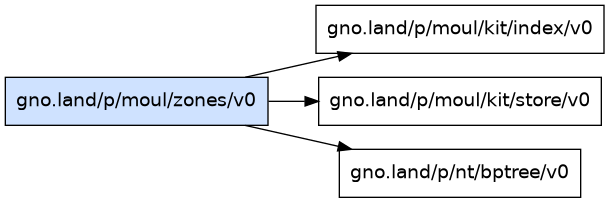
Dependency graph:
⚠️ Disclaimer: provided as-is, without warranty; not security-audited. Full disclaimer: DISCLAIMER.
