v0 source realm
Package gallery is a curated index of art on gno.land, in whichever form the reader can actually consume.
View source
gno.land/r/moul/gallery/v0
A curated index of art on gno.land, in whichever form the reader can actually consume.
It stores no art. Every piece lives in somebody's realm; this one renders the ones it can import and points at the ones it cannot. There is no package-level state anywhere in it, so there is nothing for a redeploy to wipe and nothing it pays storage for.
Rendered, or linked, and it says which
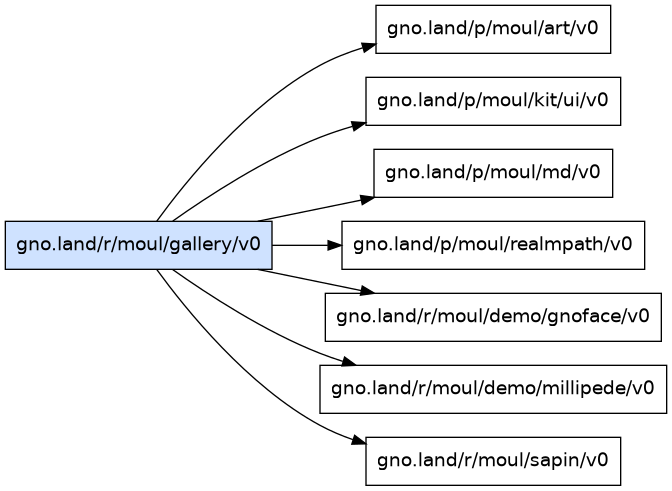
| rendered here | the source realm is public, so the gallery imports it and calls it live: gnoface, millipede, sapin |
| linked | the source cannot be imported, so the gallery points at it and says so rather than showing an empty box |
asciiart is the honest case: it declares private = true, which means no realm
may ever import it. That is a constraint of the chain, not an omission here, and
the piece page says exactly that.
The target is a parameter
Every page answers to ?fmt=txt as well as the default markdown.
The text target is not markdown with the characters deleted. It is a different document built from the same content:
- A link prints its text inline and collects the URL into a numbered footnote
at the end. Never
[text](url), which is the single worst thing markdown does to a terminal reader. - A heading is underlined (
=for H1,-for H2), not prefixed with#. - A table gets columns padded to their widest cell, under a rule. An unpadded pipe table is the other thing no amount of character-stripping fixes.
- Art is emitted verbatim: never wrapped, never escaped, never fenced. A consumer that asked for text asked for the picture as it is.
- Prose wraps at 72 runes. A word longer than that is left alone, because a realm path is worse broken than wide.
/r/moul/gallery:?fmt=txt                 the index, pipeable
/r/moul/gallery:piece/millipede?fmt=txt  one piece, art and all
?fmt=ansi is deliberately absent. Colour cannot reach gnoweb:
p/nt/markdown/sanitize strips control bytes and raw ESC is garbage in HTML, so
a realm offering it would hand every web reader a page of escape bytes. Terminal
colour is p/moul/art's Canvas.ANSI, for a consumer that asked for it over
something other than gnoweb.
Where the text renderer lives, and why it is here
text.gno holds doc, a small plain-text document builder. It is a
prototype, deliberately in this realm rather than in a p/ package.
Porting one realm is not enough to know what a shared document model should be;
porting the fifth will be. What it already pins is the list of five rules above,
which is the part that was actually unknown. When a second realm needs it, it
graduates to p/moul/doc and this file becomes an import.
Adding a piece
catalog() in catalog.gno, one struct literal. Set Draw to a closure over
the source realm's function when the realm is public and vendored; leave it nil
and the gallery will link the piece and say why it is not rendered.
The catalog is built per call rather than held in a package-level var: a func value is not something to persist, and a realm that stores nothing should not be paying storage for its own index.
Part of moul/gno-contracts — moul's versioned gno.land contracts. See the repository for the full catalog, build/test tooling, and usage.
Dependency graph:
⚠️ Disclaimer: provided as-is, without warranty; not security-audited. Full disclaimer: DISCLAIMER.
Package gallery is a curated index of art on gno.land, in whichever form the reader can actually consume.
It stores no art. Every piece lives in somebody else's realm; this one renders the ones it can import and points at the ones it cannot.
The target is a parameter
Every page answers to ?fmt=txt as well as the default markdown. The text target is not markdown with the characters deleted: links become numbered footnotes, headings get underlines instead of a leading '#', and art is emitted verbatim rather than fenced. The result is meant to be piped, or read by anything that is not a browser.
?fmt=ansi is deliberately absent. Colour cannot reach gnoweb, so a realm that offered it would be handing every web reader a page of escape bytes. Terminal colour is p/moul/art's Canvas.ANSI, for a consumer that asked for it over something other than gnoweb.
