A discussion block any realm can embed, keyed on the page it appears on
rather than on the realm that stores it. Two lines in the host realm, which
stores nothing:
RenderBlock takes no argument because it does not need one. A plain read
exported by a realm and called by another opens no realm frame, so
unsafe.CurrentRealm() inside it reports the caller: the host realm's own
path is the page key, and nothing has to be configured, registered or passed.
RenderBlockFor(page) is the explicit form, for a realm that renders several
pages or already holds its path as a constant. Adding a cur realm parameter to
either would silently reverse that and key every embed to this realm.
It is the text half of
r/moul/reactions:
the same embed shape, the same page keys, and the same reason for existing.
The token, and the three things it has to answer
THREAD is a GRC20 issued through
p/moul/x/social/coin,
which refuses to create a token until all three of these are written down:
mint
1 THREAD to a thread's author, the first time each distinct address replies to it. People, not messages, and never yourself.
sink
Boost burns 10 THREAD to pin a thread to the top of its page for 1,000 blocks. It is the only thing that removes supply, and the only thing the token does.
buyer
anyone who wants placement and has not earned it. They have to acquire THREAD from somebody who did, with Transfer.
Placement is the one thing a discussion has that people want and cannot all
have at once, which is what makes it a sink worth paying for rather than a
leaderboard. A pin extends from whichever is later, now or the current pin, so
buying one never shortens somebody else's, and Boost charges before it pins.
It is farmable, and saying so is cheaper than pretending otherwise: two
addresses replying to each other mint one THREAD each per thread. The fix is a
gate on who counts as a replier, which belongs in
r/moul/x/social/vouch
and not here. Until then the cost of farming is one transaction per point and
the benefit is capped by what a pin is worth.
The token is registered with r/nt/grc20reg, so a realm that does not import
this one can still find and move it by key: TokenKey() returns it.
Why this realm is not private
Every other realm in the x/social family is private = true and can be
redeployed in place. This one cannot be, twice over: a private realm cannot be
imported at all, which would delete the embed, and handing an object to another
realm (registering the token) panics at runtime from a private realm. Every
thread, balance and pin under this path belongs to the people who wrote them, so
a fix ships as a v1 beside it rather than as a redeploy that wipes the lot.
Reading it
Render("") is the index: the counts, the recent threads across every page, the
token's three declarations, and the embed snippet. Render("page/<page key>")
is one page's threads, Render("thread/<id>") is one thread with its replies and
the reply and boost buttons.
Part of moul/gno-contracts — moul's versioned gno.land contracts. See the repository for the full catalog, build/test tooling, and usage.
On mainnet:
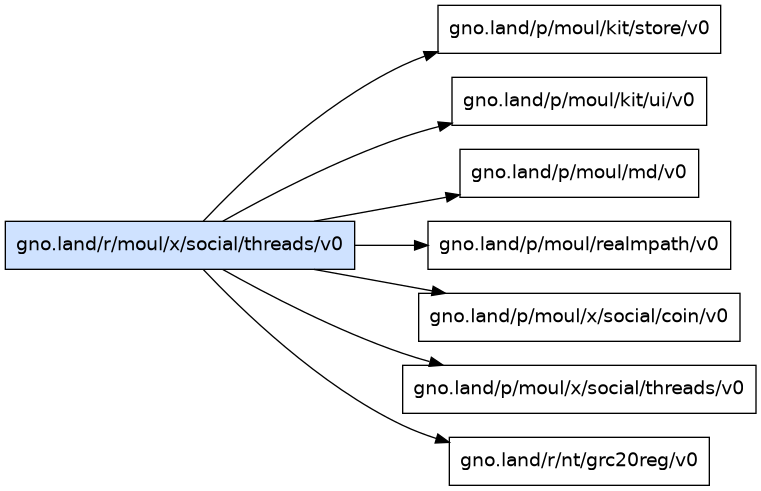
Dependency graph:
🧪 Highly experimental — potentially vibe-coded. Not audited; may break, change, or be removed at any time. Do not use with anything of value. Full disclaimer: DISCLAIMER.
Overview
Package threads is a discussion block any realm can embed, keyed on the page it appears on rather than on the realm that stores it.
It is the text half of gno.land/r/moul/reactions: the same embed shape, the same page keys, two lines in the host realm.
RenderBlock takes no argument because it does not need one: a plain read exported by a realm and called by another opens no realm frame, so unsafe.CurrentRealm() inside it reports the CALLER. The host realm's own path is the page key, and nothing has to be configured or registered. RenderBlockFor is the explicit form, for a realm that renders more than one page or already holds its path as a constant.
The token, and the three things it has to answer
THREAD exists because placement is the one thing a discussion has that people want and cannot all have at once.
Example
1mint   1 THREAD to a thread's author, the first time each distinct
2       address replies to it. People, not messages, and never yourself.
3sink   [Boost] burns PinCost THREAD to pin a thread to the top of its
4       page for PinBlocks blocks. That is the only thing that removes
5       supply, and the only thing the token does.
6buyer  anyone who wants placement and has not earned it. They have to
7       acquire THREAD from someone who did, with [Transfer], which is
8       what makes attention a market rather than a scoreboard.
It is farmable, and saying so is cheaper than pretending otherwise: two addresses replying to each other mint one THREAD each per thread. The fix is a gate on who counts as a replier, which belongs in a vouching realm and not here; until then the cost of farming is one transaction per point and the benefit is capped by what a pin is worth.
1const( 2// EarnPerReplier is minted to a thread's author the first time each 3// distinct address replies to it. 4EarnPerReplier=int64(1) 5 6// PinCost is burned by Boost, and PinBlocks is how long the pin lasts. 7// A pin extends from whichever is later, now or the current pin, so 8// buying one never shortens somebody else's. 9PinCost=int64(10)10PinBlocks=int64(1000)1112// BlockThreads is how many threads an embedded block shows before it13// turns into a link to the full page.14BlockThreads=515)
page is a package path, the full one: "gno.land/r/moul/home". It does not have to be a realm that embeds the block, and nothing checks that it exists. A page is just a name, which is what lets a realm key discussion on something finer than itself.
Render routes three views: the realm's own index, one page's threads, and one thread.
A page key contains slashes, so "page/<key>" is split on the prefix rather than by path element: realmpath gives the parts, and rejoining them would only be a way to get it wrong.
RenderBlock returns the block for the realm CALLING it, which is the form a host realm embeds.
It has no cur realm parameter on purpose. A plain read is borrowed: gno opens no realm frame for it, so unsafe.CurrentRealm() reports the caller's path and the block keys itself with no argument. Adding a cur realm here would silently reverse that and key every embed to this realm instead.
RenderBlockFor is RenderBlock for a named page. Use it from a crossing function, where there is no caller to read off the stack, or when one realm renders several pages.
The first time each distinct address replies to a given thread, its author earns EarnPerReplier. Replying again earns nothing, and replying to your own thread never earns anything.
Transfer moves the caller's own THREAD. It is what makes the sink a market: somebody who wants a pin and has written nothing has to buy from an author.